Parkinson’s Law in the Age of AI

What is Parkinson’s Law

“Work expands to fill the time available for its completion.”

In traditional software engineering, we’ve all seen it: give a team two weeks for a sprint feature, and it takes two weeks. Give them a month, and suddenly the codebase is full of gold-plating, over-engineered abstractions, and it still takes a month.

But what happens when AI coding assistants can generate that exact same boilerplate, test suite, or refactor in 30 seconds? Does Parkinson’s Law disappear, or does it just find a new way to mutate?

Let’s explore…

  • The Velocity Illusion (Prompting vs. Thinking): AI dramatically compresses the execution time of writing code. However, if we don’t adjust our goals, the “saved time” easily gets swallowed up by endless micro-tweaks, over-prompting to get a “perfect” output, or generating massive amounts of code that we now have to spend hours reviewing, debugging, and maintaining. The work expands to fill the code review window.
  • The Shift from “Building” to “Validating”: Because code generation is cheap and fast, the bottleneck shifts. If you give an engineer a week to deliver a feature, they might spend 10 minutes generating the code and the remaining 4 days and 23 hours wrestling with architectural alignment, edge-case validation, and integration testing.
  • Scope Creep on Steroids: When writing code manually was slow, it acted as a natural brake on scope creep. You simply didn’t have time to add five extra “nice-to-have” sub-features. Now, because AI makes adding features look deceptively easy, product backlogs can expand exponentially to fill whatever timeline the business sets.

So Wisdom for the Reader

To beat Parkinson’s Law in the AI age, we have to change how we define “the work.” The goal is no longer maximizing lines of code written per hour; it’s minimizing the blast radius of generated code and ruthlessly constraining the scope of what we actually allow into production. Tight deadlines are still your best friend; they force you to use AI as a precise scalpel rather than a firehose.

Now, go fix some bugs!
Talking Tokens

Ever wondered how AI, from creating images to writing text, actually “thinks”? It’s not a monolithic brain, but rather an intricate network built from countless tiny components. To truly grasp AI’s capabilities, we need to understand its fundamental building blocks: tokens.

Think of the human brain. Its astounding ability to process information and generate thoughts comes from billions of individual brain cells, or neurons, each connecting and firing signals in complex patterns.

In much the same way, if an entire AI model is like the vast human brain, then AI tokens are its individual brain cells.

WHY

The answer lies in the fundamental nature of how computers process information, it only understands numbers.

HOW

AI doesn’t just “read” text; it breaks it down into tokens using a tokenizer. Think of a tokenizer as a linguistic surgeon, dissecting raw text into meaningful units.

The exact method varies, but the general process is:

Break Down Text: The tokenizer first splits continuous text into smaller units. This isn’t just splitting by spaces. There are different types of splitting stratgegies used, below table summarizes the pros and cons of each, and looking at it you can guess why the most popular one is Subword tokenization

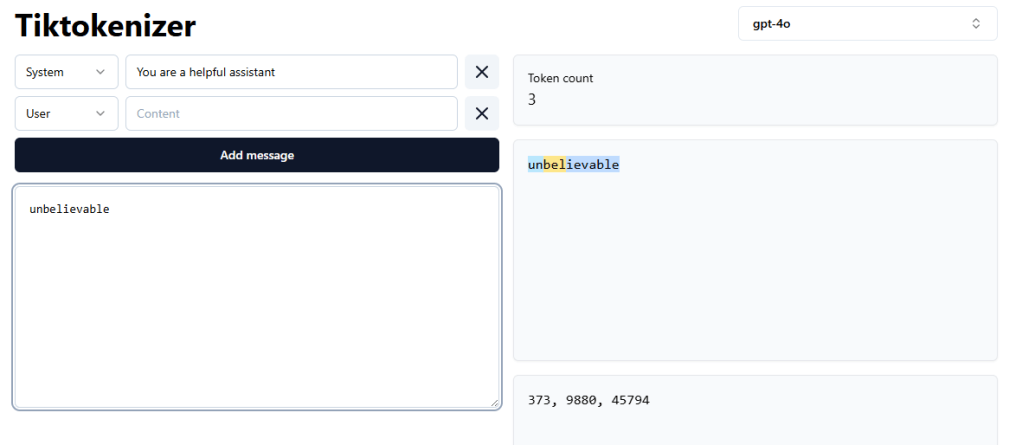
Subword tokenization (like BPE or WordPiece) is common for large language models. It smartly balances word and character-level approaches. It identifies common characters and sequences, then merges frequent pairs into new, longer subwords. This allows the AI to understand both common words and rare ones by breaking them into familiar subword units (e.g., “unbelievable” becomes [“un”, “believe”, “able”]).

Assign Numerical IDs: Each unique token is then given a unique numerical ID. This ID is the AI’s actual language (e.g., “the” becomes 123).

Great way to visualize the token generation is to use tiktok, just kidding, its to use tiktokenizer

If you simply type the word “unbelievable” you can see how one word generates 3 or more tokens.

Tokenization is a crucial step, but it’s part of a much longer journey. Significant processes, starting with data gathering and continuing well beyond tokenization, are necessary before we arrive at a sophisticated LLM like ChatGPT. This intricate pipeline owes much to the insightful, freely available content from Andrej Karpathy on YouTube. More to come.

Now, go fix some bugs!